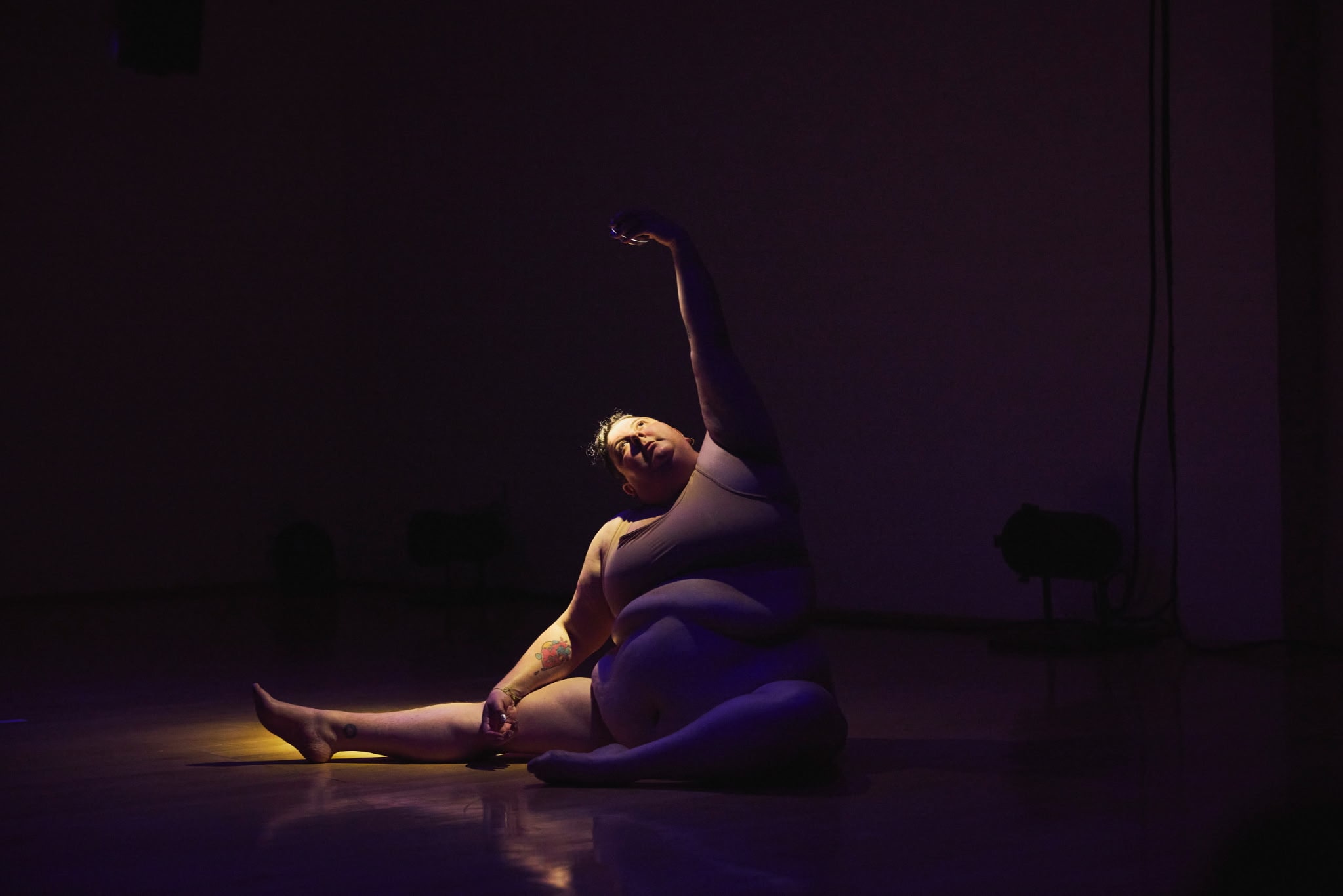
I’ve talked a lot in the last three years about the relief and insight I’ve gotten from my new and growing dance practice. In May 2026, I was one of nine cast members in Mass Movement, a performance put on by the studio I dance with, Body Home Fat Dance. The studio was started by KT Kusmaul 10 years ago as a place for them and other fat people to explore and create dance that only fat bodies could make.
I started going to KT’s Feeling Fat series in 2023 as a way to reconnect with my body as part of my trauma and eating disorder recovery. Years of disordered eating had made it hard to identify with my body, and years of chronic pain made it hard to feel my body. Feeling Fat was a freeform somatic exploration of fat bodies and movement in which KT gave us directions like, “Feel your spine” and “What if you were water?” We spent hours dancing together, over the years, choosing the movements we wanted to make, making discoveries about our bodies, individually and together.
The nature of the course being so centered around each of us as the origin of our movements meant that I didn’t have a standard to which my disabled body was supposed to meet or reach or conform. I got to make choices where the entire purpose of the movement was, “Does this speak to me? Do I want this? If I don’t, what do I want instead?”
Because of that level of freedom, I could come to dance class in a full multi-day pain flareup and still feel like I belonged and that my contribution was valued. I could still do things I loved, even if I had to do them differently because of my illness. In a world where suffering from chronic pain means not being able to go to dinner with my friends because I can’t even sit in a chair, where my body can be a distraction that keeps me from writing or talking or thinking, having a place where I could come and be valued even if all I did was lay on the floor, because that was a genuine expression of my body and what it needed, was one of the most life affirming, transformative thing I’ve ever done.
In time, the internal, individual, and specific movements of my body taught me things I’d been trying to learn sometimes for 20 years or more. One afternoon, I had a realization that has become a part of my core practice as a decolonizer and anti-capitalist. While I was in a flareup and having a lot of trouble moving because of the amount of pain I was in, I became filled with grief over what I had lost; all the opportunities I missed out on, years I spent recovering and suffering instead of living.
While in my grief, I started to explore the edges of the pain in my body, and I began to think about them not as a hole or a deficiency, but as a structure of my body - not a permanent one, but one that I was experiencing which was real and a part of me at that moment. Instead of thinking of the pain as an intruder or thief of my joy and ability, I asked myself what shape the pain was, tracing the edges of it, and thinking about the ways I could move around and with this shape, the places that I could access, whether through movement or awareness, not in spite of but because of the pain. Was the pain something I could build on, even just in this moment of lying on the floor? Were there things I could do because of the way my body was disabled, because of how I was suffering, that I wouldn’t be able to do another time or wouldn’t have thought to do without this experience?
Until that moment, I’d also been struggling with my identity as a trauma survivor, feeling like trauma had taken bites out of me and that I was missing so much because of the traumatic incidents of my life, and that the time and money spent on recovery had taken so much from me that could have been something else. Slowly dancing around my pain, I got the clear message from my body that this wasn’t just one day or flareup or movement, it was representative of all the ways I thought of myself as missing parts and pieces. I realized that there are things I’ve done with my life, knowledge I’ve internalized, paths I’ve been able to take; not in spite of my past trauma or continued efforts at recovery, but because of it. All the things I’d characterized as losses in my life were simply composed of different types of building blocks than the ones I’d been taught to value.
Because of my unique experiences, I have a rare perspective that very few other people will ever be able to have. It’s not just the trauma itself, or the recovery from the trauma, but both of them working together - the wounds I have, and the way I’m healing them. This unique synthesis creates my tools every day, everywhere I am.
While I was experiencing this revelation, the other dancers were having similar journeys. Talking about them, and workshopping these ideas coalesced into a shared ethos that, while not new to anti-racist or decolonization theory, was unique in this case because we built them with our bodies and came to similar conclusions together from feeling rather than thinking.
Some of the things we realized through dancing together was that we - fat people, queer people, disabled people - have been taught by capitalist colonizer culture that our identities and experiences made us unnatural aberrations, abject and disgusting. But in fact, our explorations, individually and together, only affirmed that we were part of the natural world, that we were in an ecosystem with all living things, that people like us have always existed and will always exist. We came to the conclusion that not only were we powerful on our own, just existing, but we were even more powerful together.
When KT started talking about putting on a full-length dance show, I didn’t want to be included. Dance for me was extremely internal and personal, and about communing with my body, not about what other people would see or say or think. I felt like I was radical enough in my public life and that I’d prefer to support my fellow dancers rather than participating in the performance.
But as the US has sunk further into fascism, I kept being reminded that the micro is in the macro, that the personal is political, but also that I specifically had experienced so much liberation as a direct result of dancing and being in community with my fellow dancers. We developed such a trust and intimacy with each other over the years of practicing. We were making something together that started inside of us and grew into protest art that we were being called to do publicly and out loud.
It became obvious that, during a period of time when people like us - fat people, chronically ill and disabled people, queer people, trans people, non-white people like me and others from the group - are being symbolically, rhetorically, and also literally assaulted by the state, that showing us in loving, intimate contact was essential. Not just for our own process of being recognized by community, but for the people who would come to our shows and see and feel what is possible when the human being and the body we live in is centered and respected through a creative process.
Now that the shows are over, I know I made the right choice by performing, and by doing this joyful work over many years. There was no goal for our dancing for a long time. When you’re birthing something, doing it for its own sake is a good strategy because the form will follow the function, and the function of dance for me was simply to be in my body, know my body, care for my body. From that small start, we created an hour-long show with a 30 minute artist talk that not only sold out in the first two weeks of tickets being sold, but also sold out again within days of us adding a fourth show. We had packed houses for every performance and incredible conversations afterwards. People told us what their bodies felt like in the room watching us dance. People cried. People in the audience understood what we were doing without us having to say a single word.
The takeaway from this experience is that starting small, going slowly, leading with my body and how it feels in the moment, has created something that I have spent decades trying to find and trying to articulate. The problem of those previous attempts is that I was going backwards, starting with the goal of creating or finding community, or being radical or teaching radicality. What is helping to usher my liberatory practice from something I do into something I am are these last three years of incremental movements - physically and mentally - that started with my visceral experience of being a disabled human in an inaccessible world.
That is the most radical, queer, anticapitalist, decolonial thing you can be: a thinking, feeling, breathing, moving human in a world that would turn you into a tool of conquest and wealth generation for the super rich. I have found my method for discovering and combatting these attempts. Yours may be different, but if you haven’t found it yet, I urge you to start with where your body leads you.
Marina Martinez-Bateman is the CEO of New Coyote Consulting and a queer, non-binary, disabled Latine who approaches their work as a consultant, coach, and fcilitator through a trauma-formed perspective. They have been dancing since 2023.